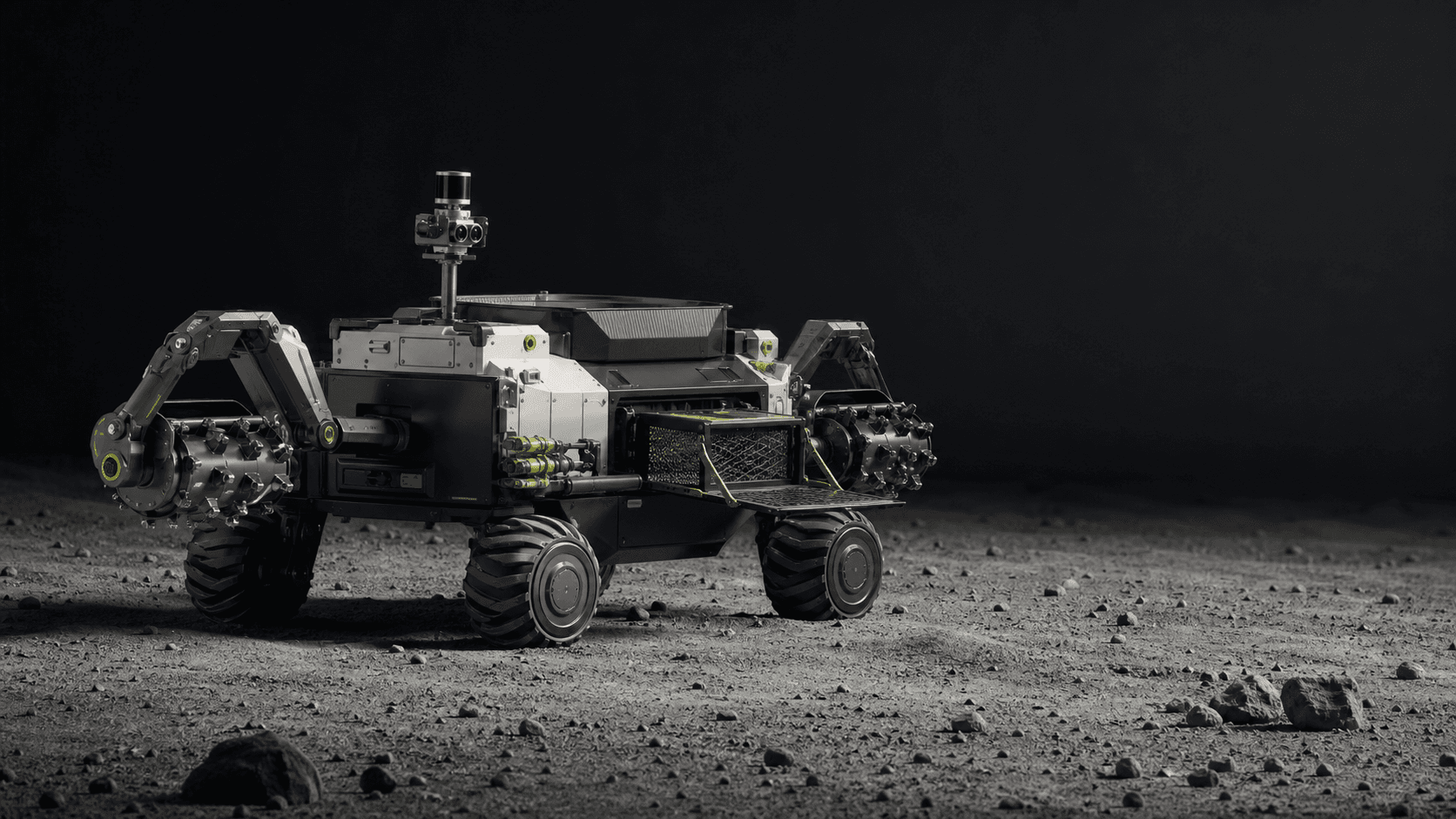
Opposed bucket drums
Two hollow drums cut in opposite directions so their horizontal reactions largely cancel. Articulated arms control shallow skim depth, lift the load and reverse to unload.
A proposed autonomous quarry rover that turns an approved patch of ground into a measured, traceable feed lot. Counter-rotating drums gather bulk loose material. The BorePod drills only when depth information is worth the energy.
A 100 mm × 1 m bore contains only about 12.6 kg at 1,600 kg/m³ bulk density. Gathering a tonne by drilling would require roughly eighty ideal full-depth holes before losses. Shallow bucket-drum passes are the credible bulk path; boring is reserved for samples, hard layers and ground truth.
Scoop separates bulk gathering, depth investigation and feed qualification so one jam or bad lot does not contaminate the full construction process.
Two hollow drums cut in opposite directions so their horizontal reactions largely cancel. Articulated arms control shallow skim depth, lift the load and reverse to unload.
A belly-stowed rotary-percussive tool collects depth-resolved samples and investigates hardpan, cemented soil or volatile-sensitive layers in controlled increments.
Stereo vision, LiDAR, inertial sensing, wheel state and tool loads maintain the local terrain map, material cell identity and energy-safe route.
Arm loads and calibrated lift current estimate carried mass. Every excavation cell, sample and delivered lot receives a traceable material passport.
LiDAR, fiducials and a compliant funnel guide docking. The rover reverses the drums into a stationary hopper without free-dumping near the process equipment.
Replaceable cutting lips, sealed drives, reversible screens and accessible cassettes make jams, wear and contaminated lots planned operating states.
The useful output is not “dirt.” It is a known mass from a known location, processed to a known envelope with every reject accounted for.
Scan the quarry cell and use the BorePod only where depth evidence changes the excavation or material plan.
Release a shallow cut depth, payload mass, keep-outs, energy reserve and route to the preparation dock.
Advance slowly while fore and aft drum torque remain balanced; lift or back out when reaction or slope exceeds limits.
Raise both drums, estimate payload from calibrated loads and stop collection at the ordered batch mass.
Verify ground clearance and follow the energy-safe corridor while preserving the source-cell identity.
Approach the P01 Prep Dock under fiducial and force guidance, then reverse the drums into its scalping hopper.
P01 rejects oversize, screens the candidate fraction and measures released feed; rejected mass keeps its own destination record.
Inspect lips and seals, clear faults, recharge if required and route back to the next released cell.
S01 begins as an Earth analog demonstrator. Every target must be measured in representative simulant before a vacuum or flight configuration is frozen.
The preparation dock—not Scoop alone—decides whether harvested material becomes released feed.
Flight hardware is not an environmental coating on the Earth demonstrator. Each world changes traction, sealing, thermal survival, power and material rules.
A first demonstrator can move simulant, map energy and wear, validate material accounting and support mining or construction-research yards under teleoperation and supervised autonomy.
See the test gates ↗A flight-derived Scoop would map, skim and deliver local regolith for screening, compaction or selective fusion. Vacuum drives, dust control, thermal survival and lander interfaces are new requirements.
Run the lunar loop ↗A Mars configuration would gather dry local mass, identify hardpan and haul qualified lots between quarry cells and the field factory while operating through communication delay.
Operate Scoop on Mars ↗Useful autonomy is the ability to recognize when to back out, preserve evidence and ask for a new plan—not the confidence to push through every fault.
Lift the overloaded drum, reduce advance and re-enter with a shallower cut.
Stop, reverse, map a keep-out and send oversize to a separate civil-fill stream.
Pause, reverse, tap or brush. Never push harder into an unclassified jam.
Stop rotation, pulse percussion, reverse and withdraw in staged increments.
Raise tools, stop and relocalize against surveyed references before any new cut.
Abort the new cut, raise both drums and return to the utility or charging pallet.
The next defensible hardware is not a lunar rover. It is an instrumented drum and BorePod program, then an S01-ET field demonstrator coupled to P01 so energy, wear, screening, recovery and material genealogy can be measured end to end.