Perception crown
LiDAR, stereo RGB, thermal and work-zone cameras maintain the visible-surface model and monitor people, equipment and the placed work.
A proposed mobile construction system that carries perception, planning, material preparation and robotic placement through the worksite—turning one fixed print box into a sequence of verified local envelopes.
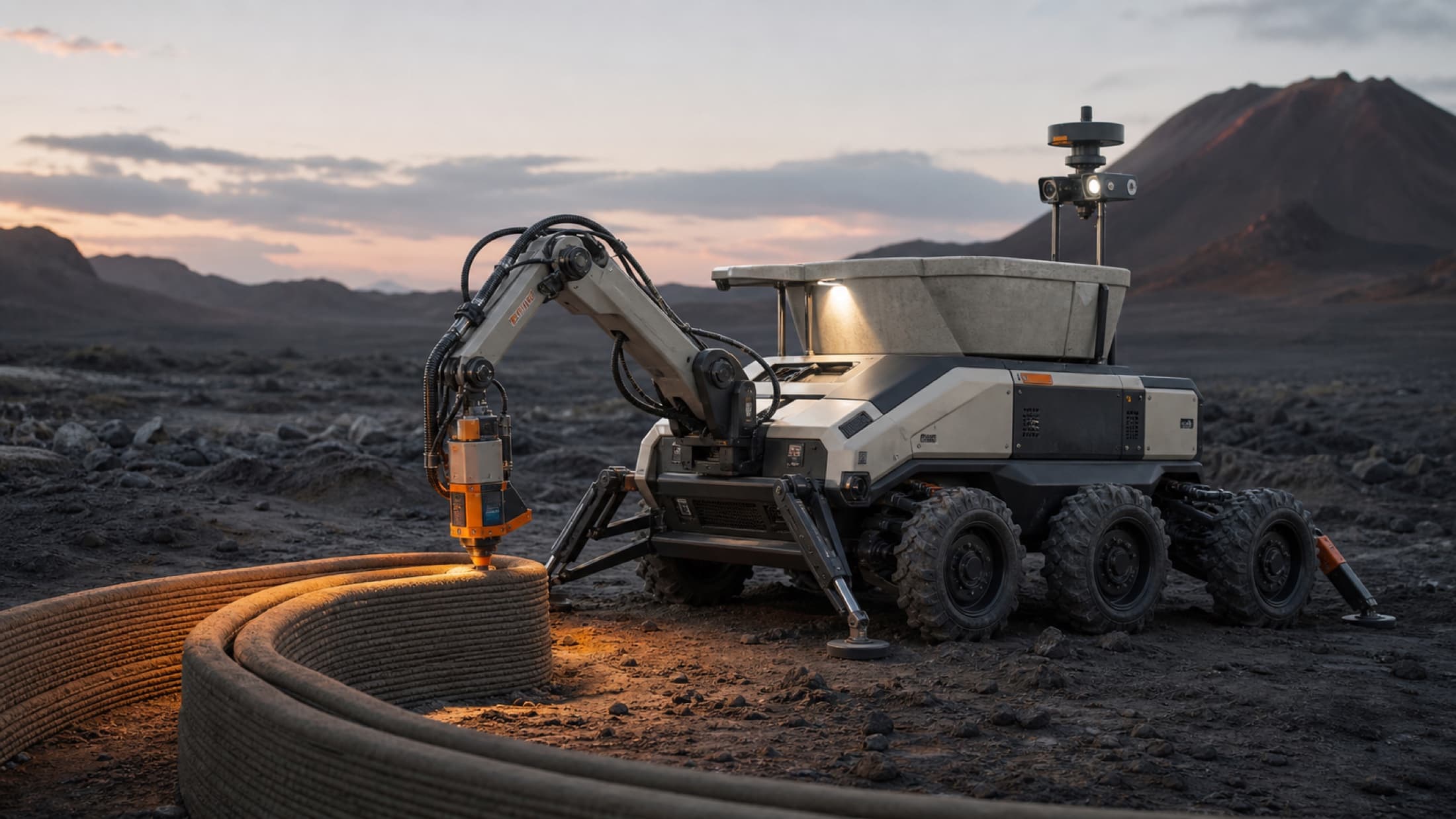
To manufacture by moving and re-registering the production frame through the site. The Rovalizer gives up the absolute stillness of a print house in exchange for route-scale reach—and must earn that trade through accurate relocation, seam control and material traceability.
No single subsystem makes a Rovalizer. Mobility, arm dynamics, wet-material behavior, sensing and safety have to close together.
LiDAR, stereo RGB, thermal and work-zone cameras maintain the visible-surface model and monitor people, equipment and the placed work.
A hose-managed manipulator carries extrusion, conditioning, inspection and future finishing tools through each stabilized local envelope.
A 650 kg dry day bin, 240 L water tank, metering system, continuous mixer, 220 L agitated buffer and reversible pump keep the wet path short.
Six independently driven wheels provide site mobility. Four outriggers create the stable, surveyed pose required for placement.
A target 118 kWh LFP pack supports motion, material processing and edge compute while a separate safety controller enforces hard limits.
A serviceable quick-change coupling separates the base platform from extrusion, grading, compaction and inspection payloads.
AI proposes. Deterministic controls enforce. Accountable people release the site, design, material and final work.
Humans define the legal work polygon, exclusions, design authority, material specification and stop conditions.
Import survey, utility, geotechnical and environmental evidence; scan visible terrain and rank build, access, staging and refill zones.
The AI planning layer proposes geometry and route options inside slope, reach, material, drainage, collision and escape constraints.
An accountable person approves a signed job package. Generative output never directly commands safety-critical motion.
Scan material lots, load dry constituents and water—or connect a qualified printable wet feed—and run preflight tests.
Drive to the first pose, deploy outriggers, verify bearing response and register the arm to site control.
Meter, mix and pump material while the arm coordinates bead width, path speed, pressure and layer timing.
Scan each accepted region, compare it with the plan and join geometry to recipe, lot, settings and exceptions.
Secure the wet path, lift the outriggers, move to the next registered envelope and continue along the route.
Capture purge and wash water, quarantine exceptions and deliver the as-built record for engineering acceptance.
These values frame the current packaging and test program. They are not certified, field-validated or offered performance.
Self-mixing is not self-supplying. A02 needs approved information, energy, material, site logistics and accountable acceptance.
Swovee qualifies the recipe and the complete machine path together. A familiar material name is not approval.
Qualified binder and 0–4 mm graded aggregate stay dry until loss-in-weight screws meter them. Water and admixtures enter the continuous mixer only when the nozzle needs material.
EARTH BASELINEPrintable mortar from a mobile batch plant enters through a keyed connection. A02 monitors temperature and pressure, agitates the buffer and pumps it without pretending ordinary ready-mix is printable.
QUALIFIED FEED ONLYCharacterized soil is dried or moisture-corrected, processed and screened before entry. A qualified stabilizer and test plan are mandatory; raw excavation never enters the baseline mixer.
PILOT / R&DThe offworld R01 branch reuses the mobile-work-envelope principle, not the Earth wet path or Earth safety case.
Best investigated first for terrain walls, drainage channels, erosion structures, utility protection, non-occupied field shells and geometrically variable site elements.
Test a build scenario ↗The mobility and registration idea may survive, but cement does not. A lunar configuration must be redesigned for vacuum, dust, thermal extremes and compacted or thermally fused regolith.
Run the lunar lab ↗A mission-derived Rovalizer could grade, form, place and inspect local mass for routes, berms and shielding. Power, thermal control and the complete feed process remain open trades.
Enter First Shelter ↗The first useful product is a bounded construction system—not an autonomous architect, contractor and building official collapsed into one machine.
The fastest credible path is an instrumented dosing–mixing–pumping bench, followed by a motion mule, then one coupled Alpha whose every placed region can be traced back to material and machine state.