A FIXED PRINT HOUSE
The object fits the machine.
- High stability and repeatability
- Controlled material conditions
- Envelope limited by rails or frame
- Object or site must come to the printer
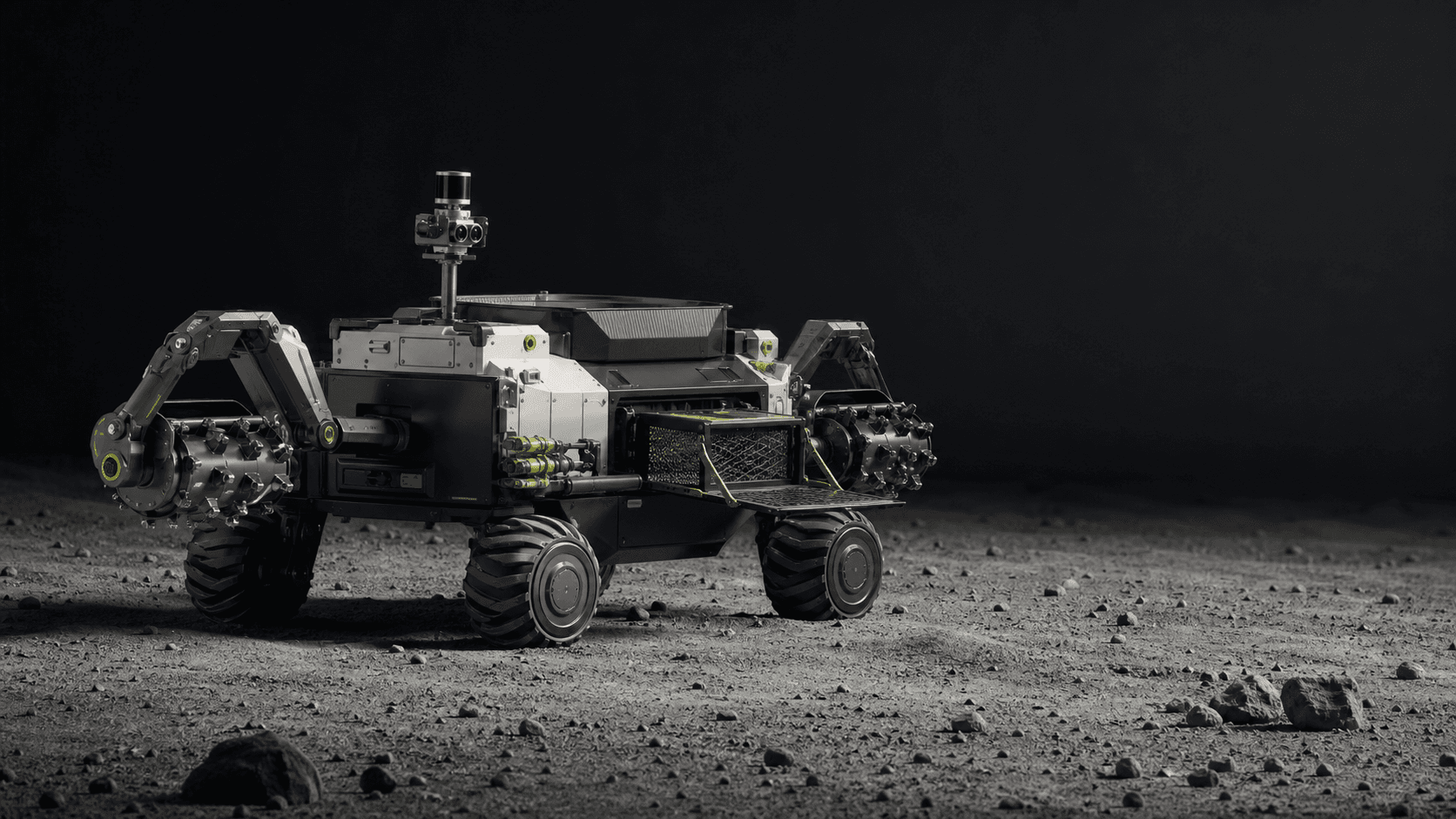
Swovee is a concept-stage mobile construction 3D printer and autonomous construction robot that scans terrain, plans within engineering constraints and places qualified material as it moves.
Starship can move unprecedented cargo to Mars. But landed mass is not infrastructure. The next multiplier is a machine that turns local terrain into useful civil works—autonomously, repeatedly and in more than one place.
SpaceX’s currently listed start for Martian surface cargo flights.
Per metric ton to the Martian surface, as currently published by SpaceX.
Swovee M01 target: installed infrastructure mass per imported system-and-feedstock mass.
THE FACTORY HAS ALWAYS BEEN THE LIMIT.
Large-format printers are powerful, but their frame defines what they can reach. Swovee—our rovalizer—combines the repeatability of robotic deposition with a field robot that can reposition, re-register and continue.
Its advantage is not that it wins every print metric. It is that it can bring a coordinated scan–plan–place loop to long, irregular and remote work where moving the world into a print house makes no sense.
verb /ˈrō-və-līz/ — to manufacture continuously by moving the production frame through the worksite.
One continuously corrected process. Human intent remains at the center; AI handles the changing geometry between plan and ground.
After survey control and site due diligence are loaded, LiDAR, stereo vision, GNSS/RTK and ground-contact sensing maintain a continuously refreshed visible-surface model.
A serviceable field architecture separates mobility, placement, perception, material, power and safety—so each can evolve without redesigning the whole machine.
LiDAR, stereo RGB, thermal and work-zone cameras on a vibration-isolated mast.
Six-axis, hose-managed manipulator with interchangeable print, spray and finishing heads.
650 kg dry day bin, 240 L water, precision dosing, continuous mixer and 220 L wet buffer.
Six independently driven wheels, articulated suspension and four precision outriggers.
LFP battery, high-voltage motion bus, real-time safety controller and edge AI computer.
Quick-change coupling for extrusion, compaction, grading and inspection payloads.
Swovee’s most important design decision is locomotion. It exchanges one enormous fixed frame for many small, accurately registered work envelopes.
AI IS NOT THE DRIVER. IT IS THE TRANSLATOR.
Semantic terrain segmentation distinguishes visible work surfaces, loose material, vegetation, people and equipment. Bearing, utilities and other subsurface conditions remain separate evidence. Confidence stays visible to the operator.
The planner considers nozzle access, slope, bead support, curing time, drainage, rover stability and escape routes—not only the target mesh.
Machine learning proposes. Deterministic controls enforce. The safety layer is independent of the AI stack and can always slow, stop or reject a motion.
Audit the proposed footprint and nearby options for surface buildability, access, drainage indicators, machine reach, material logistics, preliminary sitework and evidence gaps.
OPEN THE ASSESSMENT WORKFLOW →A02 moves the mixer onto the rover and keeps most material dry until use. That shortens the wet path, reduces material aging and makes every placed meter traceable to measured inputs.
The earlier 1.1 m³ wet hopper was too heavy and too difficult to clean. The improved architecture carries a smaller 220 L agitated buffer, a 650 kg dry day bin and 240 L of water. Large jobs use an autonomous refill pod, but final proportioning and mixing still happen on Swovee.
Each project receives a locked, lab-qualified mix passport. These ranges are only the first bench-study envelope for one cubic meter of printable fine-aggregate mortar.
Hydraulic cement plus qualified supplementary cementitious materials or filler; source and fineness locked by lot.
Washed, continuously graded 0–4 mm; moisture measured for every load; oversize screened before bin entry.
Clean process water; aggregate moisture is included in effective water. Temperature enters the process window.
High-range reducer and retarder in the base mix; accelerator may be injected only at the nozzle through a disposable static mixer.
Short, dispersible fibers; starting length limit 12 mm. Must pass bridging, wear and blockage trials.
A conservative A02 limit for the 50 mm wet path. No oversize, metal, organics, frozen lumps or uncontrolled recycled fines.
For more than roughly 0.5–0.7 m³ between refills, Swovee rendezvous with a tracked or towed support pod. The pod carries bulk dry constituents and water; dust-sealed augers and a keyed water coupling refill the rover. It never changes the locked ratio.
Binder and graded fine aggregate remain dry until Swovee calls for material. Loss-in-weight screws meter solids; water, plasticizer and retarder are dosed into a continuous paddle mixer. A progressive-cavity pump fills the short wet circuit.
Best QA + longest controllable open timeLoad cells under each dry bin, encoder-confirmed screw delivery, bridge detection and sealed dust extraction. A new material lot cannot enter a structural job without a mix passport.
Water mass flow, tank level, temperature and admixture micro-pumps close the dosing loop. Moisture correction is entered from the aggregate test—not guessed by the AI.
Mixer torque, buffer level, pump pressure, flow estimate and nozzle vision form an inline process signature. Drift outside the approved window pauses the layer.
A reversible pump, removable hose cassette and captured wash loop minimize hardening inside the machine. Wash water and purge material are contained; they are never discharged onto the site.
Swovee qualifies a material-system pair: recipe, source, mixer, pump, hose, nozzle, weather window and toolpath. A familiar material name alone is not approval.
0–4 mm aggregate; qualified pumpability, open time, buildability and interlayer bond.
SCM blend must be requalified when source, fineness, temperature or moisture changes.
Dispersible microfibers only; dose and length limited by screw, hose and nozzle blockage tests.
Separate wetted seals, chemical handling plan and verified activator compatibility required.
Pre-screened and characterized; not raw excavation. Structural claims remain project-specific.
Baseline path rejects aggregate above 4 mm. An 8–12 mm hose/nozzle system is a future research branch.
Ordinary slump concrete is generally too coarse or fluid for controlled layer stacking.
Steel bars are placed separately; future options include cable entrainment, mesh insertion or grouted cells.
Water sensitivity and washout risk conflict with the outdoor A02 mission.
Needs heated or chemically isolated equipment, fume controls and a different safety case.
A02 treats reinforcement as a parallel construction operation. Near-term structures use engineer-designed cavities, separately placed bars, grouted cells, anchors and conventional foundations. Cable entrainment and mesh placement stay in R&D until bond, corrosion, continuity and field inspection are proven.
The same mobile placement platform can move from architecture into landscape resilience, remote works and—eventually—planetary surface preparation.
Retaining walls, landscape structures, field shelters, site furniture and foundations that follow—not flatten—the land.
Curved + continuous footprintsDrainage channels, erosion controls, check dams, seawall modules and habitat-forming surfaces placed where fixed gantries cannot go.
Build at the point of needUtility protection, road-edge repair, trench structures and repeatable field works with a smaller logistics footprint and local feedstocks.
One platform · many toolsA path toward regolith berms, landing-pad edgeworks, radiation shielding and autonomous terrain preparation before human crews arrive.
Pre-terraforming, not terraforming theaterSwovee’s long-range potential is not instant planetary transformation. It is the first layer of practical terrain work: mapping local material, grading routes, printing berms and shielding, controlling dust and water, and leaving verified infrastructure for the next machine.
A fleet can divide roles across scout, excavator, rovalizer and inspector. Each machine updates the same site twin; each completed pass becomes context for the next. Mobility makes the construction system expandable without shipping an ever-larger frame.
M01 is not A02 with a space sticker. It preserves mobile perception, planning and placement while redesigning power, thermal control, sealing, materials and maintainability for Mars.
Portland-cement mortar is the A02 Earth proving medium—not the Mars recipe. M01 compacts local regolith for bulk shielding, vitrifies selected surfaces without water or binder, and reserves recycled polymer or sulfur cartridges for resource-qualified precision work.
The M01 must plan, stop, recover and ask for help locally. Earth can supervise goals—not joystick the machine.
Reduced weight changes digging force, outrigger loads, wheel slip and arm dynamics. Earth stability assumptions do not transfer.
Seals, lubricants, batteries, electronics and material conditioning need survival and operating zones—not one ambient rating.
Abrasive fines attack joints, radiators, optics and couplings. Every exposed interface needs exclusion, tolerance or replacement.
Map bearing, hazards, slopes and material classes.
Excavate, screen, grade and establish a local datum.
Add energy or minimal binder to qualified local feedstock.
Compact, extrude, sinter or shape through a modular head.
Scan, test, record and leave the site model better.
Plume-control berms, sacrificial aprons and exclusion boundaries before occupied construction.
Grade traverses, stabilize work pads and reduce dust around power, ISRU and cargo operations.
Move and consolidate local regolith around delivered pressure vessels and sensitive equipment.
Prepare cable routes, anchors, barriers and repeatable interfaces between landed systems.
Change the assumptions. The metric counts installed infrastructure divided by everything imported to produce it. A useful surface factory should compound across campaigns because the factory is reused while local mass dominates the output.
M = installed infrastructure ÷ (factory + imported feedstock)Read the full mass-ledger brief Imported32 t
Installed384 t
WHY AUTONOMY: Earth–Mars one-way communications latency varies from roughly 4 to 24 minutes.
WHY LOCAL MASS: NASA identifies autonomous construction and regolith handling as infrastructure-enabling capabilities.
Short technical briefs designed to be forwarded, challenged and improved. No lifestyle Mars renders. No implied endorsement. Every claim has an exit condition.
Measure infrastructure installed per kilogram imported. A reusable surface factory can improve after every campaign even when launch cost falls.
OPEN ENGINEERING BRIEFA landed gantry owns one box. A rovalizer owns a route—moving between pads, berms, trenches, shields and maintenance jobs.
OPEN ENGINEERING BRIEFIf the material loop, mobile re-registration or autonomous recovery cannot survive these tests, the Mars version should not be built.
OPEN ENGINEERING BRIEFSwovee will publish mass ledgers, failed coupons, pressure traces, localization drift, intervention counts and cleanout time alongside finished structures. The fastest path to attention is useful evidence.
These are first-platform engineering targets used to frame the product—not certified production claims. They will change through simulation, prototyping and field qualification.
Dual emergency stops, torque and speed limiting, redundant obstacle detection, supervised work zones, signed build plans, remote pause and a hard separation between AI planning and certified machine safety.
Read engineering gatesThe homepage carries the thesis. The engineering dossier carries requirements, interfaces, inputs, limits, tests and the people needed to build the machine.
Read online in focused sections, or take the controlled public engineering basis offline as a typeset PDF.
System boundary, operating states, physical and data interfaces, seven coupled budgets and required design artifacts.
READ CHAPTER CHAPTER 02 / MATERIALSExactly what enters the machine, how concrete is mixed and loaded, qualified media, forbidden media and cleanout.
READ CHAPTER CHAPTER 03 / OFFWORLDSwovee Scoop, waterless material modes, lunar fusion, Mars sulfur and polymer truth, delayed autonomy and flight gates.
READ CHAPTER CHAPTER 04 / VALIDATIONDeterministic safety boundary, measurable acceptance criteria, Earth and offworld development gates.
READ CHAPTER CHAPTER 05 / DELIVERYThe core team, planetary specialists, partner map and dual-track Earth-to-flight campaign.
READ CHAPTEREvery chapter opens with the question it answers, then shows interfaces and acceptance evidence before the deeper specification.
These sources frame the current concept. They are not a substitute for project-specific engineering, certification, testing or approval.
Rheology, hydration, interlayer behavior and the link from process settings to structural performance.
ISO / ASTMProcess-oriented qualification principles for additive construction of structural and infrastructure elements.
ACIThe active concrete-industry committee focused on 3-D printing with cementitious materials.
NASAResearch into autonomous construction, in-situ resources and regolith-based surface infrastructure.
ISOMethodology for safety-related control-system design; required performance levels remain application-specific.
OSHAConstruction dust exposure controls that materially affect dry loading, cleanup and field operations.
A disciplined path from simulation to limited field pilots. Timing is a planning range, dependent on financing, partners, material qualification and regulatory review.
ConOps, requirements, hazards, architecture, material strategy, digital model and supplier RFQs.
Instrumented dry dosing, mixing, pumping, nozzle conditioning, restart and captured cleanout.
Mobility, stabilization, arm accuracy, localization, re-registration and inert-media field trials.
Coupled A02 machine, closed-loop placement, safety validation and qualified mix families.
Structural basis, code pathway, trained crews, field reliability and monitored partner sites.
Give Swovee one payload ceiling, one surface mission and one unacceptable failure. We will return a first-principles mass ledger and kill-test plan—not a pitch deck.
Challenge the architecture Independent concept. No SpaceX, Tesla, xAI or Elon Musk affiliation or endorsement is claimed or implied.